Sunday, 21 May 2017

CASTING

SAND CASTING:


  • Sand is used for moulds, the sand is especially prepared to contain oils that act as binders to help hold its shape while the hot metal is being cast into it. Image result for sand casting diagram
- Advantages of sand casting:
  1. Complex 3-D shapes can be produced.
  2. Core can be used to produce hollow sections.
  3. It's appropriate for small runs.
  4. Automated processes are suitable for longer production runs.
- Disadvantages of sand casting:
  1. Due to the poor surface finish, some machining will be necessary.
  2. It's not as accurate as die or investment casting.
  3. It has a low rate of output and is therefore suitable only for small production runs.

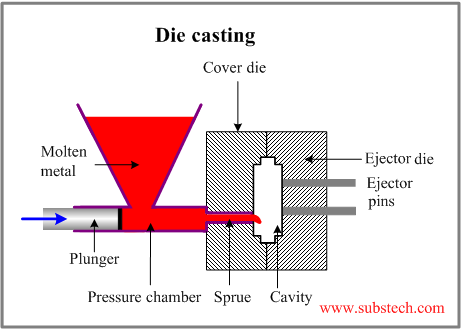
Image result for die casting diagramDIE CASTING:

  • Die casting is the term used for the processes of casting metals with a low melting point into alloy steel dies (or moulds). It is known as a permanent mould process, and the molten metal either enter the mould under the action of gravity or it is forced into the mould under pressure.
  • The processes involved in die casting vary due to the amount of pressure/force applied to the molten metal as it enter the mould. In general, the higher the force applied, the quicker the process and the finer the detail being produced.

--> GRAVITY DIE CASTING:

Image result for gravity die casting diagram
  • The molten metal is poured into the dies through runners.
  • The process uses the force of gravity to ensure the molten metal reaches all parts of the metal mould.
- The dies are made from alloy steel and are split to allow for removal of the completed product.
- Gas rings around the outside of the die keep the mould heated, ensuring even cooling of the cast metal.
- Fluxes are also used to prevent oxidation of the meta as it is being cast.

INVESTMENT CASTING:

  • Old process
--> Process = (STEP 1) A wax pattern is produced to a high degree of accuracy. (STEP 2) This is then coated in a high temperature ceramic material, by dipping the wax pattern into the ceramic slip. When a sufficient thickness of ceramic material is achieved, it is left to dry. (STEP 3) Once dry it can be fired in a kiln. This will course cause the wax pattern to melt (hence the alternative term for this process 'lost wax casting') leaving the cavity to be cast into. (STEP 4) When the ceramic mould has cooled, the molten metal is poured in. This is generally done using gravity to help fill the mould. (STEP 5) When the cast has cooled, the ceramic mould is broken open thereby destroying it and leaving only the cast products.


Image result for investment casting diagram


Typical products of investment casting are:
  • turbine blades for jet engines
  • tools and dies for a variety of applications
  • motorcycle steering head components
  • valves and controls for the food industry
- Advantages of investment casting:
  1. Good finishes can be obtained along with a fair degree of accuracy.
  2. Complicated shapes that cannot be produced by other casting process can be made.
  3. Complicate shapes can be produced in materials that cannot be machined.
  4. There is no split line showing on the product.
-Disadvantages of investment casting:
  1. The cost is very high.
  2. The size of components is limited by weight.

PLASTIC FORMING METHODS


VACUUM FORMING:

  • A process where sheets of thermoplastic polymer are heated and formed to shape by the application of a vacuum to 'pull' the material down onto a simple mould. Image result for vacuum forming

THERMOFORMING:

  • A form of vacuum forming.
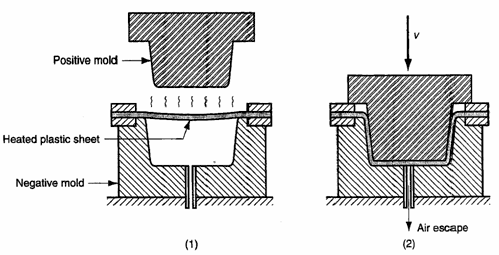
  • The main differences are that air pressure and an additional female mould assist the forming process, to enable greater detail to be achieved.
- Advantages of thermoforming:
  1. It's a low cost process.
  2. It's good for smooth shapes with additional detail.
- Disadvantages of thermoforming:
    Image result for thermoforming
  1. Deep moulds result in a thinning of the wall thickness where is has been stretched.
  2. It's limited to simple designs.
  3. Trimming is usually needed.
--> Process = Sheet material is heated to just above its softening point and then held securely in a frame between the two mould halves. The mould halves close as the same time a vacuum is applied through the lower mould. The upper mould ensures the required amount of detail is achieved.

EXTRUSION:

  • Used to produce plastic products that have uniform cross-section. Examples include curtains rails. window frame sections, guttering etc. The process can also be used to insulate wires and cables with a polymer.
- Advantages of extrusion:
  1. Generally a low-cost process that requires only simple dies.
- Disadvantages of extrusion:
  1. It can only produce continuous cross-sectional shapes.
--> Process =  (STEP 1) Thermoplastic powder is placed in the hopper; this powder then falls onto the rotating Archimedean screw, which in turn pushes the material towards a heated section of the extruder. (STEP 2) The heaters soften the plastic, which is then forced through the die by rotating the screw. (STEP 3) On exiting the die, the plastic is then cooled using a water jet. (STEP 4) Further along the transfer table, the product is cut to the required length.

Image result for extrusion moulding

CALENDARING:

  • A process used to manufacture thermoplastic film, sheet and coating materials. Generally PE and PVC are used to create the sheet. For example, LDPE shopping bags.
Image result for calendering--> Process = (STEP 1) The rollers are heated to just above the softening point of the thermoplastic. (STEP 2) During the rolling process, the plastic 'dough' is forced through the gap roller. These rollers determine the thickness of the material. (STEP 3) The final roller is the 'chill' roller that cools the material.


LINE BENDING:

  • A method of processing sheet materials, in particular thermoplastics; limited to producing simple shapes.
Image result for line bending

Saturday, 20 May 2017

METAL FORMING METHODS

TECHNIQUES:

- Press Forming:
  • Is carried out with the material at room temperature. The process relies heavily on the ductility of the material being pressed. If insufficiently ductile, the material may have to be annealed to increase its ductility.
  • Press-forming is carried out using a punch and a die which are both manufactured from toughened die-steel; this makes them resistant to impacting loads, and wear from contacting the material being pressed.
  • Car body panels are pressed from mild steel sheet to produce the vehicle's overall shape once assembled. The complex shapes produced require the generation of very high stresses to overcome the resistance of the materials being pressed.
- There are advantages of pressing a sheet material to a more 3-D shape, including that of great increased stiffness. This has the benefit of reducing the amount of material necessary to build the vehicle to a good safety standard.
- In addition to forming to shape, press tools can also incorporate shears to cut sections away. For example, cutting the holes in a car body for the windows and door panels. Other examples of press formed sheet materials include domestic radiator panels, kitchen products such as meat trays and cooker tops.
Image result for press forming diagramRelated imageRelated image

- Cupping:


Image result for cupping press forming diagram


- Deep-Drawing:
Image result for cupping press forming diagram

- Drop Forging:
  • Drop forging is used where larger numbers of similarly shaped objects are required, for example spanners and hip replacement joints. Drop forging is a refining process. For example, a piece that has been drawn down to a rough shape will be placed between a pair of drop forging dies.
  • The upper half it attached to a vertical sliding hammer. Very large forces are exerted onto the metal blank between the die halves, forcing it into the shape of the dies. It is usual that the component being produced will pass though a number of dies before the final shape is achieved.
- Advantages of drop forcing:
---> To highlight the advantages of drop forging over casting and cutting to manufacture a product we can use an engineer's spanner as an example. These advantages also apply to other products where large forces may be applied and where it is essential that the product does not fail, e.g g-clamps, engine pistons and crankshafts.

SPINNING:

    Image result for spinning diagram
Image result for drop forging diagram
    
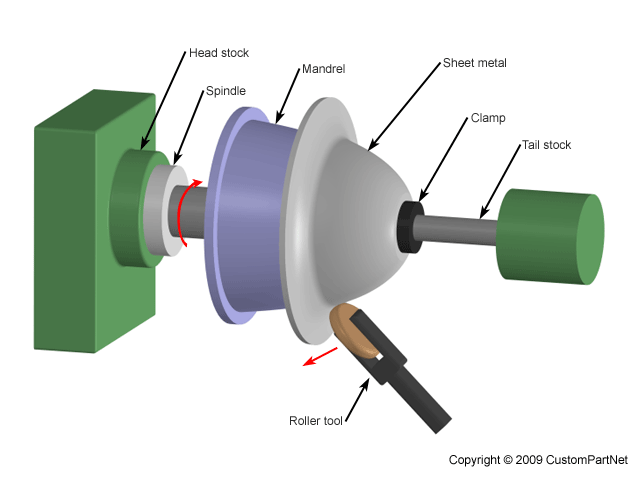
  • Spinning is a traditional process used for forming 3-D hollow objects from flat sheet metals. The process involves a measured circular sheet of material which is gripped in a machine similar to a lathe.
  • Products manufactured in this way include saucepans and woks, prior to having a handle fitted. The tell-tale signs of spinning are the concentric lines around the outside of the product, denoting the path of the tool.

-          Sintering – a process whereby powder particles are fused together at their contact points between other particles.

-          The process of sintering:    relies on the materials being crushed into a powder, the powder is compacted into a die which will eventually give the product its final shape, the compacted shape is then heated to promote bonding between the particles of the material.

-          Typical products manufactured in this way are cutting tool tips and hard magnetic products made from cobalt.

-          Also used in the ceramics industry

-          Also known as powder processing - the range of manufacturing processes for metal or ceramic powders.

-          The process is exactly the same for cements as it is metals

-          Sintering is an appropriate process for materials that are difficult to process in any other way.


ERGONOMICS AND ANTHROPOMETRICS

ERGONOMICS: Ergonomics is the study of the interaction between the human body, products and the surrounding environment. It is a key fac...